Rookies and seasoned marketing professionals alike will find Joseph's book to be a simple and engaging read. He explains concepts with agility and flair, often incorporating brand examples we know well, but adding a new twist.
Conversation
What's Your Experience?
Be Good To People
In April 2009, we made a presentation at the In-Store Marketing Institute's Summit on the convergence of the retail and digital spaces. In that presentation, we made an assertion, based on the research we conduct every month on changing shopping behaviors in the U.S., that we are living in an age of conscious consumption. Conspicuous consumption is dead.
So it was interesting to see this business at a farmer's market a couple of weekends ago.
Be good to people is a small business with a big purpose. They are trying to create a movement that will make the world a better place. And it all starts with shopping or, more specifically, the purchase of apparel and lifestyle accessories that carry the mission of the business. As the company's Web site says:
It's performing simple acts of kindness, and recognizing others for their "Good."
It's a renewed feeling of hope, relief from today's negative news.
It's joy in simple things. Returning to basic, core values.
It's communicating a shared belief, like-minded people spreading a positive message.
It's a movement.
Changing the world, one person, one kind act, at a time.
The idea is simple.
It's black and white.
When you buy something from them, 5% of that money goes to their People Being Good to People Fund. From this fund they recognize and reward people who do good and are good to others all over the world.
Simple.
Perhaps this it is the merging of conscious and conspicuous consumption - telling the world how great you are through your shopping behavior. While the notion of using your purchasing power to do good (such as productRED™) is nothing new, this is such a simple humanistic message, a reminder to us all of basic values we should all uphold everyday, that it has the potential to be very successful. It's a great conversation-starter and a philosophy that, I hope, has few detractors.
So sign up with them on their facebook group, pick something up, and see where that coversation takes you.
Keeping Shoppers Engaged and Interested - A New Loyalty Model?
All the stats show that loyalty and reward programs are on the rise (Colloquey Talk). Most shoppers are opting in simply to save money. (Forrester: Building Lasting Customer Loyalty). That makes sense, especially given the current state of the U.S. economy. However, is saving money enough to keep shoppers engaged and coming back for more?
I’ve come across some unique, different and creative ways brands are trying to recruit and keep shoppers engaged and, more importantly, keep them coming back. It’s a slightly different approach than the typical credit-card or loyalty-card program.
Receipt Treat – Starbucks® offers the following to all patrons who make a purchase.
Pick of the Week – Starbucks offers a free iTunes® download every Tuesday to all patrons.
Starbucks still uses its Starbucks Reward programs.
Free Nutritional Coaches and Nutritional Classes/Seminars From Vitamin Cottage® (a natural grocery store). No purchase necessary, no signing up, just free personalized and customized advice based on questions submitted by shoppers.
First Drink on Us and 10% Off Food Items from Baker St. Pub & Grill®
A card handed out to nearby employees of businesses giving 10% off all food items and the first drink for free at all of their upcoming visits. No signup required. No expiration date.
These different approaches suggest the following:
#1 – Brands are relinquishing some of their control over shoppers. No required shopper information is needed to engage and interact with the brand in the above examples.
#2 – These retailers are giving value-added perks to all of their shoppers, not just to those perceived to be the most profitable. This flips the traditional CRM model on its head. Equality to all shoppers, not just to a select few.
#3 – These examples provide more ways for shoppers to benefit from a brand relationship versus just saving money on products. These acts by brands actually provide more value to shoppers, raise brand opinion, increase brand loyalty, increase store visits, and ultimately increase purchase amount and frequency.
A New Model?
At its very basic definition, the model of a traditional CRM/loyalty program is to determine how the brand can leverage shoppers in its database to its own advantage – in other words to maximize the brand’s profits. The above examples suggest the makings of a flipped model where shoppers benefit by receiving the most personally relevant value from the brand.
This leaves me pondering still more questions. What do you think?
• How should brands determine what constitutes the strength of the relationship with shoppers, outside of financial profitability? What are these behaviors? Purchase, Web visits, downloads, posts about their brand on blogs, etc.?
• Which model is the right model?
• Should different models be used in different economic situations?
• Is there any value in practicing both models simultaneously?
• Should brands think about the strength of a relationship with shoppers vs. how profitable a shopper can be to them? Long term vs. short term?
• What forms of value (other than savings and discounts) can brands give shoppers that are meaningful and relevant? That cost the brand little to no money?
To be Social or Not to be Social?
It’s around us everyday - we tweet, update our Facebook status, become 1 of 948,543 fans of Skittles, research how to cure a hangover on Wiki.com, upload pictures from Vegas to Picasa, and write on our blogs before even taking showers in the morning.
Social media is all around us and is becoming a normal part of our daily lives. Because social media use is now equivalent to watching TV (an everyday occurrence), brands are finding ways to connect with consumers in this space in a variety of ways. Brands use social media to appeal to audiences, to engage with their consumers, and to leverage their brand advocates.
Comcast - Helping Customers.
A majority of us have had problems with our cable/Internet provider - the cable goes out, the Internet is running at a snail’s pace, or the bill is beyond the comprehension of someone who didn’t major in math at Harvard. This past year, Comcast added a Twitter division (Comcast Cares) to its Customer Service department to help respond to the immediacy/instant gratification desired when current Comcast customers have problems with their service. Numerous Twitter users tweet about bad experiences/frustrations they have with Comcast. Comcast searches for those comments among the Twitter database and can be directly connected to the frustrated Tweeter via the Twitter Direct Message button, so they can privately discuss issues via e-mail.1
Check Out the TBWA\ MAD blog
MAD – An entertaining and inspiring destination for creative minds and opinion-makers beyond the advertising industry. This is where big ideas, great brands, the doers and media artists intersect, united by a passion for smart thinking and the love for Media Arts and Disruption.
It’s where experiences are shared, brand behavior can be experienced, and ideas are accelerated. mad-blog.com offers a fresh perspective, reinventing the conventional talk about tomorrows brand behavior.
Click here to view. We've also added it to our favorite links.
User-generated (dis)content
Take a look at the latest issue of the Pulse from our Integer Midwest office here. They talk about the power of negative peer-to-peer recommendations via social networking and the effect it can have on your business. They term it "user-generated (dis)content" and "for every 100 people online, one will create, 10 will interact, but 89 will view it."
And check out past posts from our Des Moines office in the Integer Pulse section under Our Thinking.
Creating a lasting dialogue with Tweens
Would you believe that Tweens -- usually defined as 8 to 12 year olds -- have an overall purchasing power of $260 billion dollars annually? Between their own personal, disposable income of around $11 billion and the $250 billion directly spent on Tweens by their parents on things such as holiday gifts and school clothes, this massive monetary force is a noteworthy fact for retailers and marketers. (AllBusiness.com, January 2005)
 According to a recent article, around 87% of 10-14 year-old web crawlers go online three times a day. With money burning holes in their pockets, the Tween group turns to the Internet with 40% collecting information about purchases they want to make utilizing mostly Google (78% compared to the 14% who use Yahoo). From those searches, over a third reported that their online efforts yielded results that had “extreme impact” on their purchases. (MarketingCharts.com, July 2008)
The success of Tween-centric media such as Hannah Montana, “High School Musical”, and the Jonas Brothers exemplifies that not only have Tweens become a sizable, distinct demographic, but also that many marketers have already taken aim at this influential group. Questioning the proper way to communicate with Tweens reveals an ethical conundrum. The line retailers and marketers walk is extraordinarily thin: we want to create a dialog with Tweens rather than executing the usual competitive sales techniques.
 The most important idea for retailers and marketers to note is that tween shoppers are no different than their adult counterparts in many ways: both want their messages hassle-free, informative, and respectful, though Tween consumers are more drawn to music and humor rather than rebellion, angst, sex, and cynicism. And they value their privacy: Tweens want e-mails kept to a considerate minimum and do not want to be bombarded by marketing gathering questions. It's clear that the conversations we start with Tweens today will mean the difference between establishing a lasting dialog with or alienating this influential group for years to come.
- Contributed by Alli Sands
Integer Pulse
Click the Integer Pulse tab under the Our Thinking section for a monthly update from our Midwest office. They explore some really interesting topics surrounding the shopping world. This months issue uncovers a trend/counter-trend they call "Get Real|Unreal World" which dives into the mindset of today's consumers. Getting real about spending habits while at the same time longing to escape to an unreal world.

Starbucks caffeinates sales with a shot of CRM
After two quarters of declining sales and executive-level scrutiny on brand health following reports that the company is straying too far from their brand roots, Starbucks is introducing five new initiatives to realign the company with their true identity. Interestingly, the most attention is being placed on CRM (customer relationship management) approaches to reward their most loyal customers and better understand their needs and desires. One of these initiatives is a standard customer loyalty-rewards program at retail, and another is a new style of website for customers and employees to share thoughts with the people who run the company.

It appears Starbucks is practicing these concentrated CRM tactics to reclaim their position of being the customer's "Third Place" with home and work being number one and two. Third places are social environments generally revolving around beverages. Starbucks is fulfilling on this mission as having become a nationally accepted "Third Place" where consumers spend lots of money, time and collaboration. With their now declining sales, Starbucks recognizes that they must take consumer interaction and entertainment to a more subtle but effective level without being too obvious. Who wants a "Third Place" that feels uncomfortable, forced or inauthentic? But that doesn't mean you have to be home-grown and primitive in your communication or approach.
Consumers will soon be seeing something new in Starbucks retail environment with a loyalty-rewards program starting in mid-April. These "on the house" perks are for anyone who buys a Starbucks card and registers the card online, because Starbucks knows they can convert them to loyal users once they get to know them better. Participants will get free refills on coffee, a free cup of coffee when they buy a bag of whole bean coffee, hours of free Wi-Fi a day and "on the house" upgrades including syrups, soy milk, and extra whipped cream on all lattes. The in-person experience will also integrate online through monitoring and MyStarbucksIdea.com.
MyStarbucksIdea.com will initially include about a dozen categories. People can post, discuss and vote for ideas in categories such as coffee, atmosphere, food, music and social responsibility. Forty-eight Starbucks employees will respond to the posts then channel suggestions back to management. "Their job is to show up every day and engage with customers about their ideas," says CTO Chris Bruzzo.
We see two important aspects of CRM at work.
Better understanding core customers. Starbucks is embracing a highly streamlined approach in communicating to and understanding their customer with this online initiative maximizing on a CRM tool which is a smart way to "get to know" your customer, communicate directly with the customer, increase their purchases and monitor and enhance their overall brand experience (Starbucks is using Salesforce which is a top CRM/Sales tool with over 800 applications like these.)
Creating a customer-feedback protocol. Starbucks is getting great ideas directly from their customers creating a sense of involvement in the experience and overall ownership and participation by the customer. They actually show when the consumer's suggestions are "under review" or "coming soon". Each suggestion is acted on; people can view results by participating in this forum. While the suggestions are a form of user-generated content that others enjoy to read, vote on and celebrate successes when Starbucks adopts the new ideas, these comments are also indicative of Starbuck's general business model. The comments imply that Starbucks moves fast and get things done.
Other companies like Dell have joined Starbucks in implementing these innovative tools. Visit www.dellideastorm.com to see the Dell CRPM application taking hold.
We suggest more brands step outside of the comfort zone and taste-test CRM and digital technologies to understand how simple and straightforward they can be. Cost-effective technology is at your fingertips where consumers literally "tell you" what they want, and the tools allow easy customization of direct communication to niche audiences. These techniques could make a venti difference in your sales.
- Contributed by Tracy Kollker
Conversation to drive shopping - an experiement II
It has taken me too long to get to my promise of reading this book. My mistake, as if you have even a vague interest in how to ensure your brand is a success in the future then I recommend you give this a read. Joseph Jeffe (who also wrote Life after the 30-second spot) has set up this experiment to use new marketing to prove the power of new marketing. In taking part, I owe everyone a review of the book.
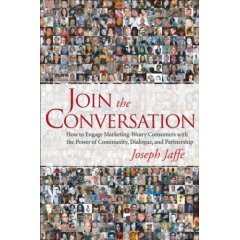 I'm not sure Joseph's writing style is to everyone's taste but the fundamental point about the change in the landscape
brands now play on and the need to re-think how we engage people is
well made and an important contribution to modern marketing.
So what did I learn from the read, given that the purpose of this blog is to host a discussion? Well, this is a book about change, evolution, adaptation and experimentation.
- It reminded me of how we all change our mentality when we cross the threshold of our places of work. We have conversation outside the building - inside, we tend to push out reams of (often) meaningless communication in the eyes of the intended recipient.
- That to partake in a conversation, you have to have something interesting to contribute - a challenge for many. How many brands in the world could hold an interesting conversation at a BBQ? Or in the aisle of a supermarket? And it's not about just opening your mouth, you have to have something to say.
- That many brands do not understand the notion of audience - otherwise the aggressive or de-humanising stance that some advertisers take would be less prevalent. Remember guys, we're all audience to something, we all talk.
- That whatever we do, brands are increasingly bouncing in the market (spoofing, generating echoes) - or they should be looking to do so. Joseph talks of the 'movement of parts of the conversation that alter and shift every time they hit the dirt'. (Although I felt the notion of a Chief Conversation Officer as a new role slightly sinister for some reason).
- The importance of listening in conversation. Something we've been doing bunch of work on in the Insight & Strategy Group here in Denver.
There are also some useful and funny stories of brands slapping their customer's for using them. I'm sure they won't bring the organisations down, but they provide useful learning for others.
The conversation carries on in a number of places. First off there is the site that accompanies the book, there is Joseph's excellent blog (and his podcasts are also worth a listen) which Morgan is an advocate of, and you can also join the Facebook group. I have also posted a similar review here.
And if you happen to be in close geographic proximity to me, or you're first to comment and ask, I'd be happy to lend you my (slightly dog-eared) copy. But I do suggest you buy yourself a copy for your own bookshelf from amazon.com.
Conversation to drive shopping - an experiement
A much respected commentator and author on all things marketing, Joseph Jaffe, is running a small experiment to improve the sales of his current book. The intention is to see if the power of the network and social marketing is all we believe it is going to be in terms of influencing purchase behaviour.
In October 2007 Joseph published a new book entitled "Join the Conversation".
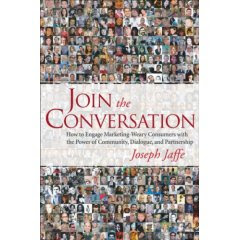 Following the success of his previous books in generating reviews with other bloggers Joseph is, once again, trying to see if he can get his book on the best seller list by practicing what he preaches. Namely, using the power of conversation among networks to improve the level of purchase. He has named it UNM2PNM (Using New Media to Prove New Media). As his blog says...
'The underlying thinking behind this effort was that I would use the very approaches in my book to help market it and in so doing, would turn the book into its own case study.'
Obviously that kind of thinking appeals to us at Integer, and Joseph has offered a free copy of the book to different industry bloggers in return for their honest review of it. So we are going to be reviewing the book in the near future and take part in the experiment to try and use the power of this network and the conversation generated here can help to influence and encourage you all to shop for it (assuming it is any good of course).
It will be interesting to see what happens given the amount of book clutter that exists and free IP that is generated in the blog sphere - will the power of social media that we expect be able to move the needle and encourage greater purchase?
In the meantime, if you want to grab a copy of the book for yourself in advance, you can do so at amazon. And do let us know if you buy a copy as a result of this post alone.
About


Mobile Apps


Our Thinking


Subscriptions
Want our latest thinking delivered straight to your inbox? Subscribe to all our thinking pieces, or simply the reports you are interested in.

Search
Categories
- Advertising
- App
- Audience Understanding
- Blogs
- Books
- Brand Experience
- Branding
- C-Store
- Club
- Conferences
- Consumer Behavior
- Consumer Electronics
- Convenience
- Conventions
- Conversation
- Coupons
- Creativity
- CRM
- Current Affairs
- Design
- Digitail™
- Disruption
- e-commerce
- Effectiveness
- Exclusive retail
- experience
- Experiment
- Film
- Food and Drink
- Glocalization
- Grocery
- Health & Beauty
- Hispanic
- Holiday
- Impulse
- In-store media
- Innovation
- Insight
- Integer Pulse
- Interactive
- iPhone
- Localization
- location-based
- loyalty
- Luxury
- Macro trend
- Mass
- Media
- Mobile
- Music
- On-line shopping
- P.R.I.S.M.
- Packaging
- philanthropy
- Placement
- Point of Sale
- Pop-up retail
- Presentation
- Private label
- Product Trial
- Promotion
- QR codes
- QSR
- receipts
- Religion
- research
- Research
- Resources
- Retail
- Retail Rebranding
- Retail strategy
- RFID
- Science
- Segmentation
- SEO
- Shopper Behavior
- Shopper Culture
- Shopper Culture study
- Shopper Marketing
- Shopping
- Shopping mindsets
- Shopping modes
- Social Media
- Sourcing
- Sports
- Store Experience
- Strategy
- Surveys
- Sustainability
- Sweepstakes
- Technology
- Television
- Tesco
- Testing
- The Checkout
- Travel
- Trend
- Vending
- Video
- Viral
- Wal-Mart
- Walmart
- Web/Tech
- Weblogs
- White Paper
Favorite Links
Recent Posts
- Online Shopper Engagement: Good Deals Vs. Fostering Relationships
- New Tech Players Lighting Up the Retail Space
- Passport To Purchase: M-Commerce
- The Evolving Multi-Cultural Shopper
- The Checkout: DIGITAIL® Report
- Google Helps Bridge the Online Gap Once Again
- Wishing You A Happy Holiday!
- Ideation Nation
- Black Friday = Check-in Friday
- Retail Rebranding: The Brand Filter


