On-line shopping

Is 'Bargaining' the wave of the future?

Watching the Today Show one morning last week, and then 9 News here in Denver that same evening, I saw similar stories about the rise of bartering by consumers. 

According to these reports, in the United States at least, consumers are beginning to bargain with national retailers to negotiate pricing. The Today Show specifically talked about how New York consumers were beginning to “bargain down” the prices. Walking into stores along 5th Avenue, shoppers are speaking with sales associates and managers to get the pricing down to a level that they are comfortable paying. Initially it took me a few days to digest this.  I was completely in awe over the concept of walking into a high-end retailer – say Tiffany’s – and speaking with the manager to “barter” with him on the price! This is something that many of us would do when vacationing in Mexico, or when in China on a business trip as it is part of the culture in those countries, but in US retailers? 

The thought has occurred that our current economy could easily be pushing us in a similar direction. Not only might that be beneficial to the shopper but it can also benefit the retailer if they are able to move their inventory quickly and generate a sale. But is America daring enough to barter in this way? Is it ready culturally? We have all seen the rise of bartering over products online – EBay, Craig’s List, etc.  But, that’s online and there is no face-to-face contact involved, nobody to cast judgment over what you are doing. Yet bartering online had to start somewhere, as does bartering in person I suppose.  The 9 News piece has interesting tips for how to approach it; things like who to talk to in the store, where to start, how to do your research beforehand, etc.

It will be interesting to see if and how this will evolve over the next economic cycle.  How will this change shopping habits?  What will be the response of marketers and brand owners? Advertising and other communication?  What does this indicate about our country and the US shopper / retailer relationship?  Is bargaining the wave of the future?

- Contributed by Tera Gill
   

Conversation to drive shopping - an experiement II

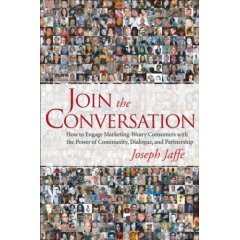
It has taken me too long to get to my promise of reading this book. My mistake, as if you have even a vague interest in how to ensure your brand is a success in the future then I recommend you give this a read.  Joseph Jeffe (who also wrote Life after the 30-second spot) has set up this experiment to use new marketing to prove the power of new marketing.  In taking part, I owe everyone a review of the book.

I'm not sure Joseph's writing style is to everyone's taste but the fundamental point about the change in the landscape brands now play on and the need to re-think how we engage people is well made and an important contribution to modern marketing.

So what did I learn from the read, given that the purpose of this blog is to host a discussion?  Well, this is a book about change, evolution, adaptation and experimentation.

- It reminded me of how we all change our mentality when we cross the threshold of our places of work. We have conversation outside the building - inside, we tend to push out reams of (often) meaningless communication in the eyes of the intended recipient.

- That to partake in a conversation, you have to have something interesting to contribute - a challenge for many. How many brands in the world could hold an interesting conversation at a BBQ? Or in the aisle of a supermarket? And it's not about just opening your mouth, you have to have something to say.

- That many brands do not understand the notion of audience - otherwise the aggressive or de-humanising stance that some advertisers take would be less prevalent. Remember guys, we're all audience to something, we all talk.

- That whatever we do, brands are increasingly bouncing in the market (spoofing, generating echoes) - or they should be looking to do so. Joseph talks of the 'movement of parts of the conversation that alter and shift every time they hit the dirt'. (Although I felt the notion of a Chief Conversation Officer as a new role slightly sinister for some reason).

- The importance of listening in conversation.  Something we've been doing  bunch of work on in the Insight & Strategy Group here in Denver.

There are also some useful and funny stories of brands slapping their customer's for using them. I'm sure they won't bring the organisations down, but they provide useful learning for others.

The conversation carries on in a number of places.  First off there is the site that accompanies the book, there is Joseph's excellent blog (and his podcasts are also worth a listen) which Morgan is an advocate of, and you can also join the Facebook group. I have also posted a similar review here.

And if you happen to be in close geographic proximity to me, or you're first to comment and ask, I'd be happy to lend you my (slightly dog-eared) copy. But I do suggest you buy yourself a copy for your own bookshelf from amazon.com.

Conversation to drive shopping - an experiement

A much respected commentator and author on all things marketing, Joseph Jaffe, is running a small experiment to improve the sales of his current book. The intention is to see if the power of the network and social marketing is all we believe it is going to be in terms of influencing purchase behaviour. 

In October 2007 Joseph published a new book entitled "Join the Conversation".   Following the success of his previous books in generating reviews with other bloggers Joseph is, once again, trying to see if he can get his book on the best seller list by practicing what he preaches. Namely, using the power of conversation among networks to improve the level of purchase. He has named it UNM2PNM (Using New Media to Prove New Media). As his blog says...

'The underlying thinking behind this effort was that I would use the very approaches in my book to help market it and in so doing, would turn the book into its own case study.'

Obviously that kind of thinking appeals to us at Integer, and Joseph has offered a free copy of the book to different industry bloggers in return for their honest review of it. So we are going to be reviewing the book in the near future and take part in the experiment to try and use the power of this network and the conversation generated here can help to influence and encourage you all to shop for it (assuming it is any good of course).

It will be interesting to see what happens given the amount of book clutter that exists and free IP that is generated in the blog sphere - will the power of social media that we expect be able to move the needle and encourage greater purchase?

In the meantime, if you want to grab a copy of the book for yourself in advance, you can do so at amazon.  And do let us know if you buy a copy as a result of this post alone.

Retail at music gigs

As a fan of live music, and a musician myself, I recently made my way to the Fillmore Auditorium where the Brian Setzer’s Orchestra was performing. Brian Setzer has performed with a number of guitars, but his primary “ax” is a Gretsch “Hot Rod” – a flashy hollow-body that Setzer designed to his own specifications. Brians


Gretsch markets and sells the “Hot Rod” as a signature model within the Brian Setzer series.  Of course, as a consumer, you can only purchase a brand new “Hot Rod” at retail outlets like Guitar Center.

What's this got to do with retail?

I wasn’t at Guitar Center when I recently encountered the “Hot Rod” – I was at the Fillmore.  Prior to the acts beginning, I spotted a Gretsch Guitar “pop-up” display positioned around stage right.  The pop-up featured a large graphic panel highlighting the cover of Brian Setzer’s latest CD and an even larger image of Brian himself cradling a vintage Gretsch guitar. Below was a rather large assortment of the Gretsch guitars - beautifully shimmering in a variety of luscious colors.


Neither Gretsch or Brian Setzer are brands of the masses – they can’t compete on that stage.  To that end, marketing has to be targeted and the messaging truly engaging. Communicating within an active environment where consumer are open, receptive and can interact with the brands on a purely emotional level heightens consideration.  Breaking through the clutter and noise at traditional retail outlets like Guitar Center or Virgin Music isn’t efficient for these brands or meaningful to the consumer.

While the messaging was specifically targeted at Setzer fans and Gretsch guitar enthusiast, the venue provided natural transitional moments (waiting for the show to start or that time between acts) where consumers felt comfortable interacting with the brand.  How often do brands try to reach us when we are rushed or the setting isn’t natural?

Equally, how often do celebrities endorse brands where the endorsement feels neither real nor relevant? Is a Buick really the car of choice for Tiger Woods? He knows golf inside and out, but what is his credibility with cars?

Brian Setzer knows guitars.  Brian Setzer designs guitars.  Brian Setzer shreds a guitar like no one else.  Brian Setzer plays Gretsch.  I get it.  I believe it.

So, to rephrase the question - is this retail?

At The Integer Group, we have started to think of retail as: 

“Any environment (physical or virtual) that has been constructed to process or facilitate an exchange of items of value (transaction).”

G6120shb_xl

This certainly was a physical environment and the intent was to elicit a transaction between audience and brand – I gave my time and Gretsch allowed me an intimate product experience.  I also gave something else.  Next to the row of glittering guitars was a computer kiosk.  Many of us enthusiastically gave away our names, addresses and e-mail addresses for a chance at winning a Brian Setzer autographed signature Gretsch.

Later comes the true test of audience/brand engagement.  Buying a Gretsch represents a high involvement purchase – they run about $3,000.  None of us at the Fillmore were prepared to pull out our debit cards and take one home, but I imagine (and hope) I will soon start getting e-mails and further messages from Gretsch as they have now pegged me as someone hopelessly climbing from consideration (yeah I would like one) to intent (damn, I need one).

Gretsch wasn’t selling that night and no one was making a purchase. What they did do was to place a permanent brand image squarely within the right hemisphere of my brain – the part where creativity flourishes and any inkling of reason and rational decision-making is noticeably absent.  For me, my aspiration of owning a Gretsch is the epitome of practicality.  It makes all the sense in the world.

No, they weren’t selling that night, but I was buying – buying into the realization that I really needed that guitar.

Now that’s retailing.

- Contributed by Paul Ballew

Building your brand on secondlife.com?

Although this YouTube video is primarily focused on highlighting the paradigm shift in mass communications to 1-on-1 communication, the more important message here is about the opportunity to build a brand in a virtual, social environment.

Check it out:

Consistent with characteristics of a community, second life is made up of residents that create their world, their identity, and choose their friends. More importantly, they thrive on word of mouth recommendations. As viral communication thrives, Secondlife provides yet another platform for sharing.

Residents create avatars reflecting their personal identity in this virtual world. And many brands are already taking advantage of this. Avatars can visit the American Apparel virtual store to view the latest clothesline, buy Dell computers, and read news updates from Reuter.

Secondlife_main_485And you thought is was all for online gamers, recently Secondlife became one of the cutting edge virtual classrooms for major colleges and universities including Harvard, Stanford, and Princeton. Administrators host lectures, inform students of projects and chat live outside of the traditional classroom.

The future of the virtual platform is at its infancy.  At a virtual world conference in October 2007, IBM and Linden Lab announced plans to develop open standards that will allow avatars to roam from one virtual community to the next. The goal is let a person create a digital alter-ego that can travel to many virtual worlds, keeping the same name, look and even digital currency.  And Secondlife isn’t the only opportunity to get involved.

If you’re not sold yet, there are hundreds of ad, design and marketing agencies dedicated to creating destinations and opportunities on Secondlife. If hundreds of companies are being created to simply service this platform, it’s definitely not a fad.

With the increase of clean-store policies, companies must build their brands out of store to influence that purchase decision before they walk in the door. And with consumers spending less time with traditional media and more time online, companies must shift dollars to reach them.  Promo Magazine Industry Trend Report for 2007 reported that marketers are spending 32% of their promotional dollars online (only higher medium was Direct Mail) to generate promotional support. 

From tracking consumer “IM” relating to your product to testing a new product before it hits the shelf, Secondlife provides research capabilities as well. These residents are early adopters and will champion new products if you give them the opportunity. Building brand loyalty takes time and trust, and Secondlife provides a highly-targeted medium to reach current and future customers.

Afraid of jumping in and taking a risk? You should be more afraid of getting soaked on the sidelines from your competitors' cannonball.  It’s just a matter of time before your competitors announces their presence. Andrew McGregor expressed this in the YouTube piece, but I agree. “In five years, the brands with the most social presence online, will also be the most competitive in the marketplace.”

- Contributed by Kelly Walz

Lil' Wayne gives consumers a choice

When your favorite band announces they will be going on tour do you cross your fingers hoping your city is on the list?

The other day I was online looking to buy tickets to a Lil' Wayne concert (we can talk about my taste in music later) but he was only playing on the East Coast and I live in Colorado. So unless I wanted to buy a plane ticket I was out of luck.

Picture_2

Then I came across www.weezylive.com, a website offering a live stream of the concert for only $5. Quite a deal considering the alternative.

With record sales declining over the past couple years artists have had no choice but to become more innovative with the way they get their share of your wallet.

MSN has even taken notice of the trend.  At music.msn.com you can view concerts from major artists like Jay-Z and Maroon 5 but they aren't live. There is something different about being able to see the show in real time that makes you feel more a part of the experience.

This is a smart way for artists to generate a larger fan base while making some money along the way. Greater access to products (or services) and increased consumer choice is always a good thing because it opens the door to new audiences.

iTunes allowed consumers to purchase single songs, opening up the market to those who wouldn't have purchased a whole album. Now promoters may be able to do the same with concerts. By lowering the price of entry artists may find listeners more willing to experiment with new music.

This is interesting to me because a concert ticket is such an inelastic purchase. You either go to a concert or you don't; you either ante up the $60 or you don't. Lil' Wayne has created some sort of a middle ground. I wonder where or how this could translate into other shopping experiences? And I don't mean the ability to buy a Banana Republic sweater online instead of going to the store. But what other shopping experiences do you still think require your physical presence? Or what other shopping experiences do you enjoy so much that you choose to physically be there even when it can be done online?

Imagine a virtual spot in line for the release of next year's must-have gadget, where you can chat with other like minded enthusiasts while waiting to be the first to get your hands on the product. All from the comfort of your own home. The retail experience of exclusivity (being the first to get something), community (interacting with others), and the event (waiting in line) can all be done online. This could be an interesting place for retail brands to explore - the hybrid space between online storefronts and offline experiences.

Can you really tell shoppers what to buy?

An interesting piece in the Weekend Wall Street Journal this Saturday prompts a question regarding how shoppers are engaged to buy a product.  The article talks about high-end boutiques and retailers in New York City calling or emailing consumers to tell them which expensive items their loved ones would like or might be interested in.  It's part of a growing trend by these retailers, both on and off-line, to increase their holiday retail sales...and for some consumers it's a god-send, yet for others it's an unwanted intrusion.

While the article depicts a fairly "narrow" circumstance, it does point to the opportunity to engage consumers differently.  The idea of reaching out to consumers to guide their purchases is not new - we've all received Catalina coupons in grocery stores that offer an incentive to buy a like (or competitive) product based on our purchase the clerk just scanned, and it's hard to avoid Amazon's "If you like this, you might also like this" approach to suggestive selling (which, by the way, really works).  Starbucks this past year began leveraging Apple's iPhone and the iTunes music service - shoppers walk into a cafe to buy a latte, hear music in the store, and are automatically contacted via WiFi on their iPhone with a message "If you like this song, please hit 'purchase' " and the song is downloaded to their phone. 

There are new technologies coming that will further enhance these opportunities to reach out to consumers and "help" their shopping. The advanced mobile phones from Europe and Asia that store credit card data on handsets and read RFID tags are coming to the U.S. Ean13_scan

And the ability to scan UPC codes at shelf with a mobile handset and automatically receive product information and, more importantly, consumer reviews to help select (or worse de-select) a particular product at the exact moment of purchase decision is right around the corner.  The downside is that consumers can also then determine where to go to find the best price for that product, which might not be in that particular store.  But rather than feel defensive, brands should embrace that "moment of choice" for the shopper to proactively engage the potential buyer with information (and better yet an experience) that helps them close the sale right then and there.  And ideally sets up a repeat engagement with that same buyer the next time they're in the market for the product.

Brands need to think about a broader range of influences on their shoppers.  The myriad of communication vehicles traditionally deployed to reach consumers will continue to be important.  But it's the combination of those elements with new, different contact points that will create the newest, best ways to influence purchase behavior.  As shopper behavior shifts, so the need for brand behavior to change increases, and finding ways to effectively reach out and "suggest" a specific purchase is something to add to the communication arsenal.  While right for some brands, it is appropriate behavior for all?

Contributed by Marc Ducnuigeen

* by invitation only

It seems our desire for exclusive shopping knows few bounds.  A new service launched in Europe at the start of 2007 called Claseo aims to bring exclusive fashion retailing for men and woment together with a social network environment of like minded people. 

8l You can only gain access to the site, and therefore the brand's clothing, if you are invited by an existing member.  It's the ultimate in audience direction of a brand.  As well as an ultimate in bragging rights and social one up man-ship.

As the public area of the site states:

Claseo offers uniquely designed fashion which is not available to the public. We want to connect outstanding and like-minded individuals around the world – both online and offline.

Claseo fashion items are strictly limited and equipped with a visible identification code that makes each item unique. The exclusive design makes Claseo bearers stand out in any crowd. In order to be able to purchase Claseo apparel, you need to be invited by a current member of Claseo. This means that Claseo members choose the people who are eligible to wear Claseo designs. Invitations are limited.

After you have ordered a product at our online store, you automatically become a member of our lifestyle-oriented online portal. Here, you can reconnect with your friends, get to know interesting people and find valuable information about lifestyle oriented topics. Furthermore, community members decide about the looks of every new collection and also hand in their own design suggestions.

This way the members of Claseo actively particpate in the development of the brand.

7lWe think this is a neat Disruption in the category.  Of course  social exclusivity has been around for eons, but we find the combination of an on-line and off-line element of the experience, along with the ability to let the audience direct the development of the brand, really interesting and smart.  We have always been able to identify people in a crowd who have the potential to be PLU (people like us) by their overall attire. It's easy to spot the people you think you're most likely to hit it off with when at a social gathering, but this kind of 'special hand shake'  is an interesting twist that converges these two worlds.

As with all things exclusive, someone eventually tries to take it a little more mainstream.  So where does something like this go?  Would we see this at Gap or Banana Republic in the US?  Could we see Nordstrom or Selfridges launching an exclusive service in this way that helps their shoppers identify each other in a crowd? What about Top Shop in the UK would be interesting. Where else could we see this concept going? Who could you see doing this in your market?
   

Go Shopping with Facebook

FacebookInitial information is already coming out of Facebook's big advertising event this week in New York. The addition of a Shopping application will evolve word of mouth in the online shopping arena. Discussed in an Ad Age article, the application will allow users to ability to add recent online purchases to their Facebook profile. This instant word of mouth creates an interesting addition to such successful tactics as "People who purchase X also bought Y", which have become popular on many e-commerce sites.  However, now instead of seeing what strangers are purchasing, users can be influenced by what their circle of friends are buying.

As stated in the article, according to a recent Deloitte survey, family members' or friends' comments about a product are the second-biggest influences on consumer purchases of new products or brands (after the reputation of the manufacturer or supplier).  As marketers are all trying to figure out authentic ways of creating the ever-coveted word of mouth buzz, applications like this are enormously exciting.

However, as also discussed, a potential challenge could be the online only nature of the app. With a good number of purchases researched online but still bought in the real world, how can this app be expanded to be more inclusive of broader shopping behaviors?  Seems like the addition of a "considering" feature could be a useful plus-up.  For example, if a user is on bestbuy.com looking at flat screen TVs, maybe they can add categories or specific products to their considerations.  For users this could be a useful tool to gather intelligence from a network of friends.

With more announcements sure to come, we're very excited about the the future of social networking and the ability of marketers to harness its power in authentic ways. Our VP of Digital/CRM is currently in NY at the conference and we anxiously await his return with more details.

Experience vs. Ease - Rockies misstep

Rox_tix The recent debacle of World Series ticket sales in Denver raises an interesting question.  While the Internet, in all its glory, is quite fabulous, are there some real world experiences that consumers don't want replaced?  Aside from the fact that online-only ticket sales opened up the ticket market to the entire world resulting in many many Denverites getting shut out of the game, it also robbed local diehards of a time honored tradition, waiting in line. 

Camping out in front of ballparks or music venues to get tickets to the big game or big show is a shopping experience. While many enjoy the ease of e-tail, there are many that cherish the real world experience of shopping.  They go to malls on Black Friday, hit after Christmas sales at Macy's, etc. Despite the crowds and mayhem, they go.  Similar types enjoy the badge of honor that a fan gets to wear when they say "I slept on the sidewalk for 3 days waiting to get tickets". 

Badges aside, ticket window sales also ensure that locals get an exclusive opportunity to go to the game for face-value. It is after all the local fans that have been filling seats and buying hot dogs and beer all season to support the team both financially and emotionally.

Its not exactly clear what the Rockies management was thinking... as it turns out online sales certainly didn't end up being easier for the team. More importantly, they robbed their fanbase of a brand experience.  As we think about how we create brand experiences, it is important to balance new and innovative ideas with experiences consumers have grown to expect and love.

Bulletproof Baby

Bulletproof_strollerThe new Clive Owen action movie Shoot 'Em Up takes product placement into imaginary territory with this eCommerce site, bulletproofbaby.net. 

I wonder if they ever considered pop-up retail for opening night hype.

Ebay: Shop Victoriously

Ebay has come out with a couple new TV spots that put the thrill of shopping front and center.  These are all about the outcome, the prize at the conclusion of an auction.  While another spot highlights the thrill of the hunt in all its competitiveness and passion, ultimately these folks plainly feel like, well, losers if they don't end of with the prized item.

It closely parallels something we looked into in our Shopper Study, namely the path of a shopper in a Master relationship with the retailer.

More here.

Tesco - arriving in a US neighborhood near you soon

From Craig Elston:

Tesco.  The paragon of British retailing has been getting much press in the US as they prepare to launch their Fresh & Easy Neighborhood Market stores in the American West. 

That they generate so much coverage is of no surprise.  Tesco has talked about entering the largest grocery market on the planet for some time.  And I am in no doubt that they will be a success.  Having been a customer of Tesco for as long as I can remember in the UK, their continual development of store formats and own label products will be welcome again in our house (when they get to Colorado).

The last five years or so of grocery shopping by our house in the UK was undertaken online. The fact that when you register on Tesco.com your eons worth of Clubcard data (i.e. things you have bought in the past) automatically make up your shopping list, meant there really was little need to actually go into a store for our family shop other than for something to do on a wet Saturday afternoon. 

So it was a shock (and surprise) to come to the US, have to go shopping for groceries and find ourselves faced with such choice.  Far too much choice in fact - it is completely overwhelming.  There are these huge sheds of food products, often quite devoid of any people, in which you have to choose from so many options in every category. 

And here-in lies what will probably be the key to success for Tesco; they are superb at editing.  They have made it clear that each store will have a limited, edited set of SKUs.  And no doubt each store will vary based on local demographic so that the SKU set is relevant. 

Tesco_metro Back in the UK, when I used to visit the Tesco Metro near my office in Soho at lunch time, its product range was very different to the product SKUs available in the Tesco Express by the tube station close to my home.  But both were undeniably Tesco - high quality good value products.  They just understand the neighborhood and the differences in the mindset of the shopper there. They then meet their needs through a highly edited set of products. Interestingly, it never felt like you weren't getting a choice. 

There is nothing to suggest that the Fresh & Easy Neighborhood Market concept won't be the same. Nor that local residents won't be flocking there in their droves.

More to come.

My Photo

Our Thinking

  • White Papers
  • Shopper Pulse - Trend Update
  • About the 2007 Electronics Shopper Study
  • About the 2006/07 Shopper Study

Inconvenience

  • An Inconvenience Truth
    A link to a blog where we are collecting stories about the things you find inconvenient in life.

Search


  • WWW
    shopperculture.com

The original shopper culture study

Other stuff

  • PRIVACY POLICY
  • TERMS OF USE