Music

FNAC Video Wall

Interesting idea. Engaging use of sound and motion. Interesting way to sample music.  Disappointing when it doesn't respond properly.  When you touch the CD in the wall it is supposed to change tracks, and it doesn't do that quickly enough, look what happens. 


- Contributed by Ian Whitney

Pepsi Upsets Retailers Over Amazon Deal

1shaniared_2

Pepsi’s latest foray into the digital music world has created some criticism from some traditional brick and mortar retailers, who sell both the soft drink, as well as, on-line digital downloads.
This past February, Pepsi began offering 1 billion free MP3s through Amazon's new downloadable music service.
Pepsi placed song codes on 5 billion bottles that were then shipped out to retail outlets; each free download requires five codes. Pepsi’s promotion with Amazon was launched with a high-profile Super Bowl ad featuring pop-star Justin Timberlake.

080114justintimberlakevmed5pwidec

According to Tom Ryan of RetailWire, “The deal represented Amazon's biggest-ever marketing partnership with another brand.”
According to The Financial Times, however, “critics of the deal note that Pepsi's traditional retail partners like Wal-Mart and Target are increasingly selling more and more Pepsi through their expanding Supercenters. At the same time, both sell CDs and Wal-Mart, which accounts for 18 percent of Pepsi's sales, recently launched its own MP3 download service. Amazon doesn't sell any soda.”
"You have to ask yourself why Pepsi would team up with a company that doesn't sell its products, and risk antagonizing all the people that do sell its products," said a source at one retailer.
Jeff Smith, retail consultant at Accenture, said Pepsi and other brands are being challenged in adapting the traditional way they communicate with retailers to accommodate new digital selling and marketing channels.
At the same time, one has to wonder to what extent the balance of power has shifted to favor large retailers. Will brands have to retreat from utilizing nontraditional communication mediums (and perhaps those ultimately more effective at connecting with audiences) because their efforts are interpreted as favoring their largest customers competitor?

As retailers continue to extend their reach beyond the walls of the store, diplomacy between brands and their largest retail customers becomes more critical.

Radiohead - Pay What You Want

Radiohead_2

When the British band Radiohead Radiohead proudly announced it had dropped its record label, EMI, it seemed to mark the beginning of something very different within the recording industry. Later in October, reinforcing that a change was forthcoming, the band announced that a new album would be available only on their website for downloading (no iTunes and no physical CD).

However, the biggest surprise was yet to come.

On October 10, fans of Radiohead, anxious to download their latest CD (In Rainbows) online, were struck by an interesting posting when they went to “checkout”. In the box where one would normally see the standard music pricing was a single question mark. Clicking on the question mark led to a screen that read, “It’s up to you.” Clicking on that led to another message: “No, really. It’s up to you.” Customers were invited to pay whatever they wished – and nothing appeared just as acceptable as something.

Bob Lefsetz, American music industry critic and consultant to major record labels talks about the importance of Radiohead’s actions:

“It’s not like Radiohead’s living in a different world. But they’re playing by a different rulebook. One that says the money flows from the music, that people have to believe in you, that you’ve got to treat them right.

Radiohead460_2

So what were the results of Radiohead’s “let the purchaser decide” approach? How did shoppers respond? Did their fans treat Radiohead right and reciprocate on their honest gesture?

With an estimated 1.2 million downloads during the first two days - 62% opted to pay absolutely nothing.

All of which may have prompted the bands next surprise. In December the band ceased allowing online downloads of the CD on their site and alerted fans they could now purchase the album through iTunes.

Retail at music gigs

As a fan of live music, and a musician myself, I recently made my way to the Fillmore Auditorium where the Brian Setzer’s Orchestra was performing. Brian Setzer has performed with a number of guitars, but his primary “ax” is a Gretsch “Hot Rod” – a flashy hollow-body that Setzer designed to his own specifications. Brians


Gretsch markets and sells the “Hot Rod” as a signature model within the Brian Setzer series.  Of course, as a consumer, you can only purchase a brand new “Hot Rod” at retail outlets like Guitar Center.

What's this got to do with retail?

I wasn’t at Guitar Center when I recently encountered the “Hot Rod” – I was at the Fillmore.  Prior to the acts beginning, I spotted a Gretsch Guitar “pop-up” display positioned around stage right.  The pop-up featured a large graphic panel highlighting the cover of Brian Setzer’s latest CD and an even larger image of Brian himself cradling a vintage Gretsch guitar. Below was a rather large assortment of the Gretsch guitars - beautifully shimmering in a variety of luscious colors.


Neither Gretsch or Brian Setzer are brands of the masses – they can’t compete on that stage.  To that end, marketing has to be targeted and the messaging truly engaging. Communicating within an active environment where consumer are open, receptive and can interact with the brands on a purely emotional level heightens consideration.  Breaking through the clutter and noise at traditional retail outlets like Guitar Center or Virgin Music isn’t efficient for these brands or meaningful to the consumer.

While the messaging was specifically targeted at Setzer fans and Gretsch guitar enthusiast, the venue provided natural transitional moments (waiting for the show to start or that time between acts) where consumers felt comfortable interacting with the brand.  How often do brands try to reach us when we are rushed or the setting isn’t natural?

Equally, how often do celebrities endorse brands where the endorsement feels neither real nor relevant? Is a Buick really the car of choice for Tiger Woods? He knows golf inside and out, but what is his credibility with cars?

Brian Setzer knows guitars.  Brian Setzer designs guitars.  Brian Setzer shreds a guitar like no one else.  Brian Setzer plays Gretsch.  I get it.  I believe it.

So, to rephrase the question - is this retail?

At The Integer Group, we have started to think of retail as: 

“Any environment (physical or virtual) that has been constructed to process or facilitate an exchange of items of value (transaction).”
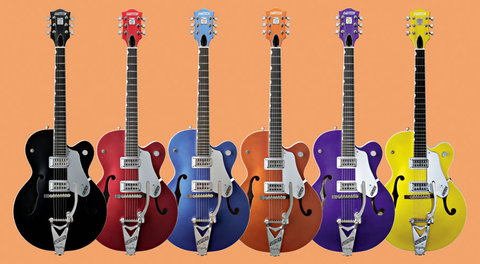
G6120shb_xl

This certainly was a physical environment and the intent was to elicit a transaction between audience and brand – I gave my time and Gretsch allowed me an intimate product experience.  I also gave something else.  Next to the row of glittering guitars was a computer kiosk.  Many of us enthusiastically gave away our names, addresses and e-mail addresses for a chance at winning a Brian Setzer autographed signature Gretsch.

Later comes the true test of audience/brand engagement.  Buying a Gretsch represents a high involvement purchase – they run about $3,000.  None of us at the Fillmore were prepared to pull out our debit cards and take one home, but I imagine (and hope) I will soon start getting e-mails and further messages from Gretsch as they have now pegged me as someone hopelessly climbing from consideration (yeah I would like one) to intent (damn, I need one).

Gretsch wasn’t selling that night and no one was making a purchase. What they did do was to place a permanent brand image squarely within the right hemisphere of my brain – the part where creativity flourishes and any inkling of reason and rational decision-making is noticeably absent.  For me, my aspiration of owning a Gretsch is the epitome of practicality.  It makes all the sense in the world.

No, they weren’t selling that night, but I was buying – buying into the realization that I really needed that guitar.

Now that’s retailing.

- Contributed by Paul Ballew

NBC embracing digital on multiple fronts

In recent months it has become clear that large traditional media companies are embracing digital in new and creative ways.

NBC, for example, has popped up a couple times in the press, or we've observed through regular viewing, as taking advantage of new ways to engage young audiences.

Mediaport_kioskThis Mediapost story covers how NBC is using Mediaport Kiosks, an ATM style machine
that allows users to download music, to feature content around their news and late night line ups. Mediaport allows customers to create custom compilations which can be burned to CDs or downloaded to various digital devices.


“The partnership is an ideal way for us to reach digital-savvy 18- to-28-year-olds," said Frank Radice, an executive with the NBC Agency. "Media kiosks have a promising future and present an exciting new channel for us to reach and influence these target groups."

Further demonstrating their commitment to things digital, during the premieres of their Monday line up (Chuck, Heroes and Journeyman), they encouraged viewers to go online and chat live with the shows producers, directors, etc… Co-media usage, which used to be feared in TVLand as it implied a less engaged audience, is now being capitalized on to provide a richer brand experience to viewers.

Chuck_twitter_2Add in their use of Twitter to promote their new series Chuck , and it is clear that rather than viewing the digital world as a threat to their viewing audience, they are using these new channels to better distribute their brands and engage audiences.
 

My Photo

Our Thinking

  • White Papers
  • About the 2007 Electronics Shopper Study
  • About the 2006/07 Shopper Study

Inconvenience

  • An Inconvenience Truth
    A link to a blog where we are collecting stories about the things you find inconvenient in life.

Search


  • WWW
    shopperculture.com

The original shopper culture study