Shopping

Integer Pulse

Click the Integer Pulse tab under the Our Thinking section for a monthly update from our Midwest office. They explore some really interesting topics surrounding the shopping world. This months issue uncovers a trend/counter-trend they call "Get Real|Unreal World" which dives into the mindset of today's consumers. Getting real about spending habits while at the same time longing to escape to an unreal world.

Picture_5_3

easySHOP: Scan and bag groceries as you shop

Picture_2In the eyes of Giant Super Food Stores, easy shopping means eliminating check-out lines. Their new "easySHOP" technology lets people scan and bag items as they shop throughout the store, then pay at a self-service check-out kiosk and leave. In other words, groceries go into your cart from the shelves and don’t leave until you get to your car.

easySHOP requires Giant’s BONUSCARD loyalty card. The system aims to empower customers by putting more control in their hands.  Further, the perception is that scanning one’s own groceries is faster than having them scanned in a check-out line. Finally, the scanner lets people keep a rolling tally of their bill, helping them stay within their budget.

Are there ulterior purposes of this system? Is this a way for Giant to better monitor customer behavior in store?  If the scanners contain RFID or GPS, Giant could track exactly how consumers shop the store: the route they take, the time they spend in each aisle or even at each shelf, the items they put in their cart (and those they put back).  Another potential benefit to the store is a reduced need for cashiers.

Shoppers might actually spend equal or more time in store doing all this scanning. But the time might not seem as long since they’re so busy scanning and bagging.

Find out more at:  http://www.giantsuperfoodstore.com/easyshop.cfm


Images from giantsuperfoodstore.com


What's in your handbag?

There is a new book out from a small research consultancy called InsightFarm that takes an intersting look at the contents of America's handbags.  Called In your purse - Archeology of the American Handbag, it contains not only the findings of the study and the insights derived, but also some ideas that are ripe for manufacturers and retailers to take hold of to improve the world of the handbag (and the women who carry them around).

Kelly Styring of InsightFarm has also put a video of the study on youtube.

This is a fascinating study that presents lots of opportunities for innovation. I thought about trying to write a bit of an overview of the work, but there is so much in it, such interesting richness, justice could not be done. I recommend you take a look at the book.

Cause and effect

A few of us sat through a presentation today that started with a bit of a love story. It involves Louis, a giant Pacific octopus who lives at the Newquay Blue Reef Aquarium in Cornwall, UK.  We were told that Louis had been pretty miserable, until at Christmas he was given a Mr. Potato Head to play with in his tank. He loves it.

Gpo_and_mr_potato_head_2 Louis was used in this presentation in the context of shopping in order to demonstrate how a small change in our environment can lead to a dramatic change in behaviour. However, when you look into the story some more, it turns out Mr. Potato Head is not only an interesting, colorful, tactile toy to enrich his existence in a tank, but it is also a way to deliver tasty treats to Louis. There was further license taken in the story told as it's not exactly clear that he was that miserable before hand! Among the brightest of the cephalopods, Louis needs mental stimulation and Mr. Potato Head delivers.  So what has caused his excitement and interest is under question. Was it the addition of the interesting toy, or the addition of the treats? 

Either way, it was an interesting metaphor (in the context of the presentation, perhaps less so here) for us to consider in shopping environments, where we need to introduce new stimuli in order to engage people and change behaviours. This little story also highlights the difficulty of isolating effects when more than one variable is changed at the same time.  We also need to be mindful that in changing one thing, we may have another as yet unknown or undesirable affect somewhere else in close proximity - after all, we don't know how his other tank mates feel that he gets all the great toys!

- Image courtesy of bluereefaquarium.co.uk

Why the price of everything is going up

An interesting article on the impact of the rising costs of Chinese manufacturing.  This means that American shoppers will soon be paying more for a wide variety of goods and that the era of the cheap Chinese import, long a factor in the US shopping landscape is under threat. Well worth a read.

- Thanks to Morgan Bryant.

Family and friends have greatest influence over our shopping

In an article in Advertising Age today, Zenith Optimedia are about to release some data that shows:

a) Friends and family are the most influential touchpoint when it comes to influencing our shopping decisions

b) TV is still top dog for creating brand associations.

What Zenith have done is create a database of all the studies they have undertaken using the Market Contact Audit (MCA) methodology, a proprietary research and analytics methodology belonging to Integration Marketing Communications that is used by many brands around the world (many agency groups have licenses to sell and use the MCA).

Being one of those agencies and having used the MCA with a number of clients as part of our Connections Planning approach (we're fans), these aggregated findings that Zenith are going to make available don't really surprise.  The level of detail they share though will be interesting.

One mistake that I've seen clients make when using the MCA is to look only at the surface level measures - like those shared in the AdAge article. What gives the most 'clout' in this category? How is our brand performing in each channel (through the association measure)? This is to miss a great deal of the value in the methodology and is a superficial look at the findings. The MCA delivers so much rich insight into the return that channels are generating, messaging effectiveness and competitor strategies amongst other things. It is a great single source approach when you know how to read it and apply it properly.  If you have any interest into how your marketing is performing and the return it is bringing, you should consider it.

Really looking forward to what the is shared by Zenith and their aggregation exercise

FNAC Video Wall

Interesting idea. Engaging use of sound and motion. Interesting way to sample music.  Disappointing when it doesn't respond properly.  When you touch the CD in the wall it is supposed to change tracks, and it doesn't do that quickly enough, look what happens. 


- Contributed by Ian Whitney

Inconvenience

We've a project going on in the Denver office on the notion of convenience. So this little blog has been set up by Paul to discuss the opposite - those things that inconvenience and bug the hell out of us.  He's looking for comment and stories about things that get on your nerves and you see as inconvenient in your day-to-day life. We thought we'd enlist our Shopper Culture readership to contribute the things that you all find inconvenient in your day-to-day life as we're sure there is a lot!

Inconvenience
So please have a look and leave your own story of things that are not convenient to you somewhere on the blog, or feel free to email Paul to add to his collection of stories. If you also find your way to pass this on to other people you know get riled up by life's little inconveniences, that would be fantastic.

Thanks

Point De Ventre - Paris

Paris recently hosted a Retail Marketing event called Point De Ventre. Ian Whitney from our Paris office went along, shot some video and made a quick presentation of some of the innovative technology that delivers meaningful shopper engagement. 


Great sign-off Ian!

Is 'Bargaining' the wave of the future?

Watching the Today Show one morning last week, and then 9 News here in Denver that same evening, I saw similar stories about the rise of bartering by consumers. 

According to these reports, in the United States at least, consumers are beginning to bargain with national retailers to negotiate pricing. The Today Show specifically talked about how New York consumers were beginning to “bargain down” the prices. Walking into stores along 5th Avenue, shoppers are speaking with sales associates and managers to get the pricing down to a level that they are comfortable paying. Initially it took me a few days to digest this.  I was completely in awe over the concept of walking into a high-end retailer – say Tiffany’s – and speaking with the manager to “barter” with him on the price! This is something that many of us would do when vacationing in Mexico, or when in China on a business trip as it is part of the culture in those countries, but in US retailers? 

The thought has occurred that our current economy could easily be pushing us in a similar direction. Not only might that be beneficial to the shopper but it can also benefit the retailer if they are able to move their inventory quickly and generate a sale. But is America daring enough to barter in this way? Is it ready culturally? We have all seen the rise of bartering over products online – EBay, Craig’s List, etc.  But, that’s online and there is no face-to-face contact involved, nobody to cast judgment over what you are doing. Yet bartering online had to start somewhere, as does bartering in person I suppose.  The 9 News piece has interesting tips for how to approach it; things like who to talk to in the store, where to start, how to do your research beforehand, etc.

It will be interesting to see if and how this will evolve over the next economic cycle.  How will this change shopping habits?  What will be the response of marketers and brand owners? Advertising and other communication?  What does this indicate about our country and the US shopper / retailer relationship?  Is bargaining the wave of the future?

- Contributed by Tera Gill


Shopping behaviour in electronics

Our Dallas office does a lot of work in the consumer electronics category and late last year undertook a study looking at what influences behaviour in this category.  This generated a fair amount of interest in the media including an interview on Fox with Kim Menier, who heads up the strategy group in Dallas.  Have a look at the interview here, and if this is your category let's start a conversation. We'd love to know your thoughts on the findings and comments Kim makes, so leave us a comment.

Conversation to drive shopping - an experiement II

It has taken me too long to get to my promise of reading this book. My mistake, as if you have even a vague interest in how to ensure your brand is a success in the future then I recommend you give this a read.  Joseph Jeffe (who also wrote Life after the 30-second spot) has set up this experiment to use new marketing to prove the power of new marketing.  In taking part, I owe everyone a review of the book.
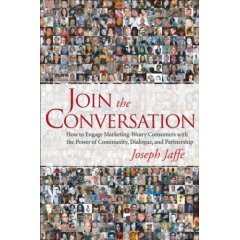
I'm not sure Joseph's writing style is to everyone's taste but the fundamental point about the change in the landscape brands now play on and the need to re-think how we engage people is well made and an important contribution to modern marketing.

So what did I learn from the read, given that the purpose of this blog is to host a discussion?  Well, this is a book about change, evolution, adaptation and experimentation.

- It reminded me of how we all change our mentality when we cross the threshold of our places of work. We have conversation outside the building - inside, we tend to push out reams of (often) meaningless communication in the eyes of the intended recipient.

- That to partake in a conversation, you have to have something interesting to contribute - a challenge for many. How many brands in the world could hold an interesting conversation at a BBQ? Or in the aisle of a supermarket? And it's not about just opening your mouth, you have to have something to say.

- That many brands do not understand the notion of audience - otherwise the aggressive or de-humanising stance that some advertisers take would be less prevalent. Remember guys, we're all audience to something, we all talk.

- That whatever we do, brands are increasingly bouncing in the market (spoofing, generating echoes) - or they should be looking to do so. Joseph talks of the 'movement of parts of the conversation that alter and shift every time they hit the dirt'. (Although I felt the notion of a Chief Conversation Officer as a new role slightly sinister for some reason).

- The importance of listening in conversation.  Something we've been doing  bunch of work on in the Insight & Strategy Group here in Denver.

There are also some useful and funny stories of brands slapping their customer's for using them. I'm sure they won't bring the organisations down, but they provide useful learning for others.

The conversation carries on in a number of places.  First off there is the site that accompanies the book, there is Joseph's excellent blog (and his podcasts are also worth a listen) which Morgan is an advocate of, and you can also join the Facebook group. I have also posted a similar review here.

And if you happen to be in close geographic proximity to me, or you're first to comment and ask, I'd be happy to lend you my (slightly dog-eared) copy. But I do suggest you buy yourself a copy for your own bookshelf from amazon.com.

The Diaper Dilemma

Clipart0250 As a woman just over a month away from having her first child I am continually awed by the strategies marketers use to target new moms; continually taking advantage of their emotional highs and lows, their raging hormones, and their fear that they won’t have everything they need to care for their new arrival – it is no wonder that this is a booming industry. I receive non-stop ads in the mail for the myriad of things that new parents (allegedly) need. How did our parents ever do it without all of this stuff?

Having just completed a trip to Wal*Mart and Babies R’ Us, I was overwhelmed by the back wall of diaper options. From Huggies, to Pampers, to generic brands. Although I did not see any eco-friendly options the choice is amazing. Where does one begin?  All of my “green” friends keep asking me if I am going to use cloth diapers, or find an eco-friendly route? As an overwhelmed pregnant women, the thought of cloth diapers is not very appealing at the moment. (Ironically none of my "green" friends have children). But in a time when sustainability and environmentally friendly are becoming everyday terms, what are my eco-friendly options and why am I not seeing them?

Clipart0093

There is no doubt that we live in an era and a culture where convenience and time are extremely important. Cloth diapers might not be an option for me, but there have to be some choices out there for biodegradable, or green products that are still convenient and easily available to me. I started searching and found a couple options. My goal was to find things that were easily accessible and didn’t cause me a trip out of my way.  Seventh Generation was the most readily available and is a disposable option. They market chlorine free / toxic free diapers. Obviously I have not tried them yet, but if they are anything like Seventh Generation toilet paper or paper towels, then I won’t want them touching my newborns sensitive skin! The price is slightly higher, and there are still conflicting reports on whether they are actually that much better for the environment than regular diapers. The other interesting option available is G-Diapers. The idea around this is that you purchase cloth velcro pants and then insert flushable refills into the pants  - making the diaper.  The flushables are plastic free and have no toxins. They are marketed around the convenience of flushing them down a normal toilet. The cost is approximately 35 – 40% more than regular Pampers or Huggies, and I can only purchase them online. It is here that the Diaper Dilemma begins!

In the baby category, filled with toys, clothing, swings and all the “must haves” for a newborn, the environmentally friendly diaper options are limited and the marketing for these products appears to be sparse (or, maybe it is just getting lost in the clutter of everything else).  New moms are easily overwhelmed and are looking for convenience, cost savings and ease of use.  It appears to me that there is a huge opportunity here, one that will make the Diaper Dilemma a little easier to solve. 

Images courtesy of DailyClipArt.net
   
- Contributed by Tera Gill

Ikea - 1 to 1 with Shoppers

Here is an interesting in-store device that comes via Unplugged.  Spotted at Ikea in Seattle was this Mobile Kiosk where you register to recieve product info. and coupons. 

IkeamobileWe all know that non of us can live without our cell phone anymore and it's role continually changes. No longer just a means to call home now it's your weather reporter/news aggregator/social networker/information hound.

With Ikea it can be a tool to know when the newest products are available in-store, and a mechanism to deliver digital coupons so you can save cash.

What is also interesting about this technology and the use Ikea is making of it is that it delivers a relevant brand-to-individual consumer (1-to-1) communication - 'Since you bought a couch last month, how about this coffee table to go with it?' - rather than a brand-to-masses communication - the usual 'Hi everyone, here's all of our stuff'. So it becomes a great brand use of data and the deigital medium in the retail space. But is it cool, or will it be annoying to get these texts about a new sofa once a week?

- Contributed by Brian Crawford

The Minority Report takes a step closer

The February 2008 edition of MediaPost had a short article about an interesting technology that was shown at the 2008 International Consumer Electronics Show that took place in Las Vegas recently.  It's a technology that moves us a step closer to a world portrayed in the film The Minority Report - that scene where tailored, targeted outdoor ads are delivered to John Anderton (the Tom Cruise character).


The technology, called the Reactrix WAVEscape, has been developed by two silicon valley companies - TYZX, a 3-D Imaging company and Reactrix, a point-of-sale display company. It uses a 3D camera mounted atop a display and it can capture movements, gestures and at some point in the future, speech.  The system can then mainputale the image (and everything else it captures) on the screen, morphing it with whatever you like.  So it sounds like a Nintendo Wii for the advertising world!

Reactrix_wavescape

While the report claims the technology is at an early stage, you can see how it could be used in an in-mall or in-store environment (or anywhere there is high traffic) to create a bit more fun for people to play around with ads. Maybe some games for local stores, with promotions and coupons as prizes?  And it is not too big of a leap to see how we could get to The Minority Report biometric recognition to talk directly at (with?) you.

- Image from gizmodo.com

My Photo

Our Thinking

  • White Papers
  • Shopper Pulse - Trend Update
  • About the 2007 Electronics Shopper Study
  • About the 2006/07 Shopper Study

Inconvenience

  • An Inconvenience Truth
    A link to a blog where we are collecting stories about the things you find inconvenient in life.

Search


  • WWW
    shopperculture.com

The original shopper culture study

Other stuff

  • PRIVACY POLICY
  • TERMS OF USE